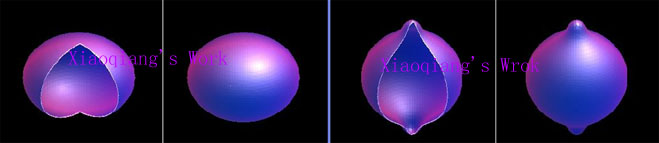
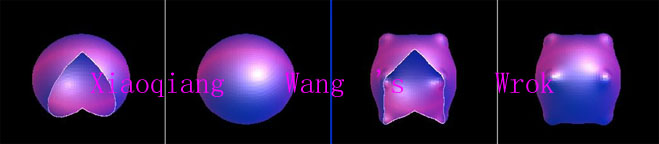
Background
Numerical simulations for biological membranes
|
|
Background |
The study of the physics of fluid biological membranes has broad applications, especially for human health. Recently, we begin to systematically study the shape deformation of vesicle membranes by numerical simulations, using a unified energetic variational formulation with phase field methods. Our final goal is to understand such deformations and its relation to the external fields and internal bulk and surface properties of the vesicle, in collaboration with biophysicists and biologists.
The usual single component biological vesicles are formed by certain amphophilic molecules assembled in water to build bilayer structure that makes vesicles simple models for the study of some of the physico-chemical properties of cell as well as of their shapes. One simplistic model is based on the principle that the equilibrium shape of such a membrane is determined by minimizing the elastic bending energy:
where H is the mean curvature of the membrane surface, a is the surface tension, b the bending rigidity and c the stretching rigidity,is the spontaneous curvature that describes the asymmetry effect of the membrane or its environment, K is the Gaussian curvature. With two constant valued a and c, the first term and the last term may be neglected as they remain constants for vesicles with a given surface area and preserving a topological structure. The problem is to study the vesicle shapes minimizing the bending energy with prescribed cell volume and surface area. One classical method for simulating a changing interface is to employ a mesh that has grid points on the interfaces, and deforms according to the motion of the boundary, such as the boundary integral and boundary element methods. Keeping track of the moving mesh may entail computational difficulties and large displacement in internal domains may cause mesh entanglement.
|
|
Phase Field Model |
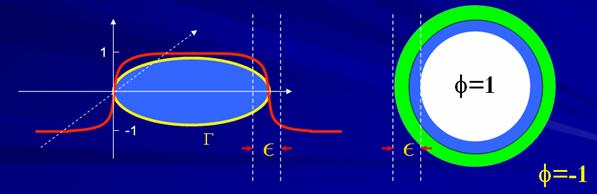
We turned to the energetic phase field models that offer many advantages including the easy treatment of topological changes of the interface. In our phase field model, a phase field function is introduced on a computational domain
to label the inside/outside of the vesicle, where the membrane
is the zero level set
while the inside is represented by the positive part and the outside by the negative part. As a typical diffusive interface description, an ideal phase field function
, where
represent the diffusive interface width. As
,
describes a sharp interface.
And we can formulate the mean curvature H by
,
Volume

and surface area
[1, 2].
Theoretically, with the help of a special ansatz, we proved that minimizing the bending energy with prescribed surface area and bulk volume is exactly minimizing
with prescribed
and
[4].
|
|
Numerical Simulations |
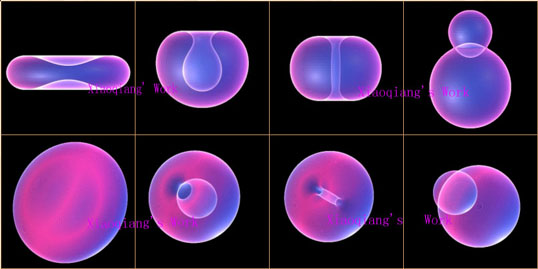
3-D view of some equilibrium configurations
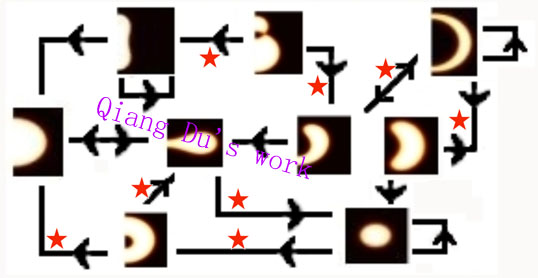
equilibrium shape transformations by changing the surface area while
fixing the volume (axis-symmetric case).
(Star pathways involve topological changes)
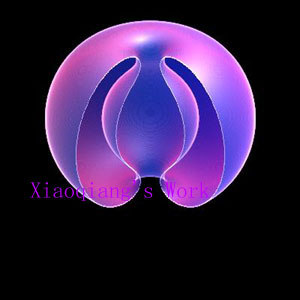
Movie
A movie for the shape transformation by decreasing the surface area (axis-symmetric case, cut view)
|
|
|
|
|
|
|
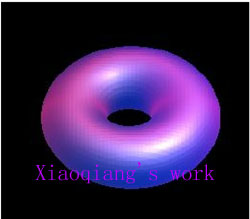
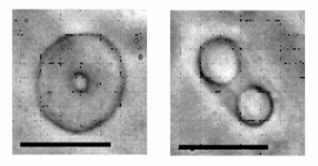
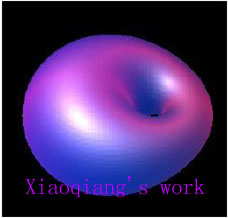
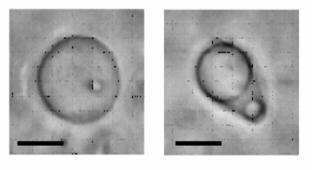
Symmetric torus and non-symmetric torus vs tori found in experiment
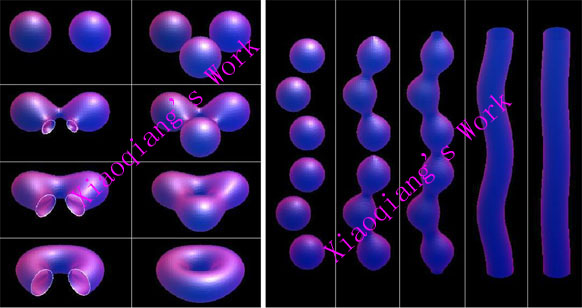
Formation of large coherent structures
from small specimen
2. Effect of Spontaneous curvature [2]
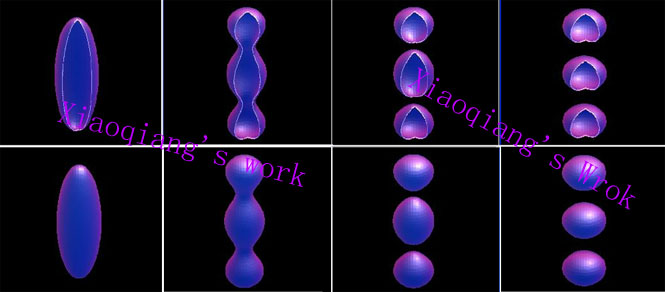
With a large constant spontaneous
curvature, an ellipsoid finally splits to three same sized sphere-like vesicles
|
|
|
|
Variable spontaneous curvature: on some
points, the surface bulks
3. Shape transformation in fluid fields [5]
|
|
Topological information retrieval |
The transformation of Vesicles may include complex
topological changes such as splitting and merging which can be easily handled
within the phase field model. On the other hand, topological information may be
needed in application and/or the membrane topology needs to be controlled. There
is a lack of discussion in the literature on how to effectively recover the
topological information of the membrane/interface within the phase field
formulation.
We showed how to retrieve the Euler number of the vesicles by the phase field
function
based on the classical Gauss-Bonnet formula. We presented the formula of the
Euler number by a general phase field function
as well as a number of simplified Euler number formulae which can be applied
under different conditions [3]. Those formulae were
successfully applied in detecting the topological changes in our experiments.
|
|
References |
Energetic variational approaches in
modeling vesicle and fluid interactions, with Qiang Du, Chun Liu and Rolf
Ryham, Physica D, 238, pp.923-930, 2009
Simulating Vesicle-Substrate Adhesion Using Two Phase Field
Functions, with Rui Gu and Max Gunzburger, Journal of Computational Physics,
275, pp. 626-641, 2014
New Asymptotic Analysis Method for Phase Field Models in Moving
Boundary Problem with Surface Tension, with Jie Wang,
Discrete
& Continuous Dynamical Systems - Series B
. Vol. 204 Issue 9, p3185-3213. 2015.
A Two Phase Field Model for
Tracking Vesicle-Vesicle Adhesion, with Rui Gu and Max Gunzburger, submitted
to Journal of Mathematical Biology, 2015.
Efficient and Stable Exponential Time Differencing Runge-Kutta Methods for Phase Field Elastic Bending Energy Models, with Lili Ju and Qiang Du, submitted to Journal of Computational Physics, 2015